
A sitewide offer generally applies across a broad range of products on a retailer’s website, but exclusions, conditions, or limits may still apply.
What Does Sitewide Mean?
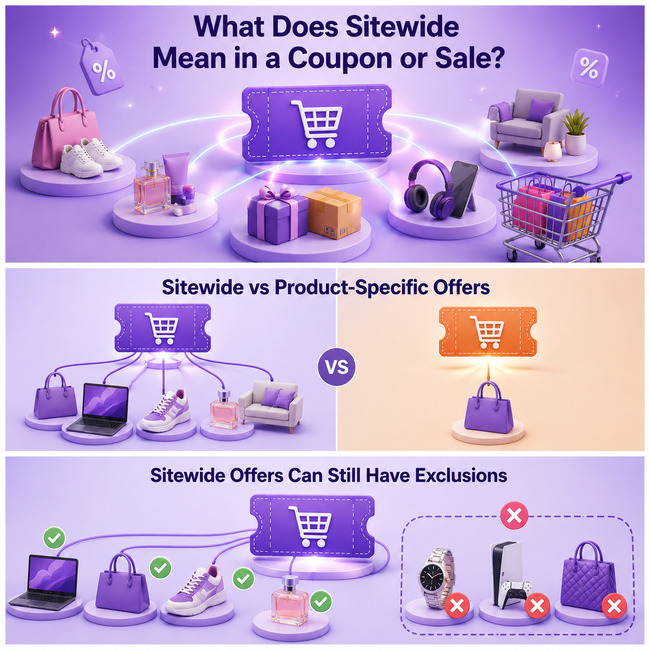
Sitewide generally means that a promotion applies across a broad portion of an online store rather than being limited to one specific product or a narrow category.
That does not necessarily mean every product on the website qualifies.
A retailer may describe a coupon, sale, or promotion as sitewide while still excluding selected items, categories, brands, or order types. Other requirements may also apply.
For shoppers, the safest way to interpret the term is:
Sitewide usually means broad coverage, not guaranteed coverage of every item.
The retailer’s own terms determine which products and orders are actually eligible.
Sitewide vs Product-Specific Offers
The main difference between a sitewide offer and a product-specific offer is the scope of the promotion.
| Offer Type | General Scope |
|---|---|
| Sitewide offer | A broad range of eligible products across the store |
| Product-specific offer | Selected products, categories, or collections |
A product-specific promotion may apply only to one item or a clearly defined group of products.
A sitewide promotion is broader. It is intended to cover a larger portion of the store, but the retailer may still apply exclusions or other conditions.
This distinction matters because the word “sitewide” can sound more absolute than it actually is. The term describes the general reach of the promotion, while the detailed terms determine where it applies.
Common Types of Sitewide Offers
Retailers may use the term sitewide for different types of promotions. The structure of the offer can vary even when the scope is broad.
Percentage-based offers
A retailer may run a promotion that reduces the price of qualifying products by a percentage.
The exact percentage and eligibility depend on the offer. A sitewide label does not mean all items must qualify.
Fixed-amount offers
Some sitewide promotions reduce a qualifying order by a fixed amount.
These offers may still include minimum order requirements, exclusions, or other conditions.
Code-based promotions
A retailer may require shoppers to enter a coupon, promo, or discount code during checkout.
The code itself does not determine whether the promotion is sitewide. The retailer’s offer terms define the scope.
If you want more context around the terminology retailers use, see the guide to coupon, promo code and discount code terminology.
Broad sale promotions
A sitewide sale may apply across many parts of an online store without requiring a code.
However, selected products or categories may still be excluded.
The important point is that sitewide describes breadth, not the absence of conditions.
Sitewide Offers Can Still Have Exclusions
One of the most common misunderstandings is assuming that sitewide automatically means every product qualifies.
It does not.
A broad promotion can still have restrictions.
Product exclusions
Selected items may be excluded from a sitewide promotion. These exclusions can depend on the retailer’s rules for that particular offer.
For more detail on how exclusions work, see the guide to coupon exclusions.
Category exclusions
A retailer may exclude certain categories while allowing the promotion to apply across much of the rest of the store.
Minimum purchase requirements
Some promotions require the order to reach a certain value before the offer can apply.
This is one example of a broader coupon restriction that can affect eligibility.
Combination rules
A sitewide offer may not combine with another promotion already applied to the order.
The exact rules vary, so the term sitewide does not tell you whether offers can be stacked.
Timing restrictions
Promotions may run only during a certain period. A sitewide offer can still end, change, or become unavailable.
These restrictions are why it is useful to read the terms instead of relying on the word “sitewide” alone.
Sitewide vs Storewide: Is There a Difference?
Sitewide and storewide are often used in similar ways when describing broad promotions.
In online shopping, sitewide usually refers to an offer that applies broadly across a website. Storewide generally carries a similar idea: the promotion covers a broad part of the retailer’s store.
There is no universal technical rule requiring the two terms to mean different things.
A retailer may prefer one word over the other based on its own marketing language.
The practical meaning is often similar:
- broad promotional scope
- many eligible products
- possible exclusions
- retailer-defined conditions
If you want a deeper explanation of the related term, see what a storewide discount means.
Examples of What “Sitewide” Can Mean
Because retailers define their own promotions, sitewide can appear in different situations.
Example 1: Broad promotion with exclusions
An online store may advertise a sitewide promotion that applies across many product categories but excludes selected items.
The promotion is still broad, even though it does not cover every product.
Example 2: Sitewide offer with a minimum requirement
A retailer may offer a sitewide promotion that becomes available only after the order meets a minimum purchase condition.
In that case, the scope is broad, but eligibility still depends on the order.
Example 3: Sitewide code with selected restrictions
A retailer may provide a code for a broad promotion while excluding particular products or categories.
Again, the word sitewide describes the general scope rather than guaranteeing universal eligibility.
These examples show why the term should be interpreted together with the retailer’s terms.
How to Check the Terms of a Sitewide Offer
Before assuming a sitewide promotion applies to your whole cart, check the offer details.
1. Read the promotion description
Look for wording that explains what the offer covers.
Pay attention to phrases that identify eligible or excluded products.
2. Check for exclusions
Look for any product, category, or order restrictions.
An offer can still be described as sitewide while excluding selected items.
3. Review minimum requirements
Check whether the promotion requires a minimum order value or another condition.
4. Check whether sale items qualify
Do not assume that items already on sale are automatically included.
The retailer’s terms should explain whether they qualify.
5. Review timing information
Check whether the promotion has an end date or another timing condition.
6. Check the order before completing checkout
If you enter a code or activate a promotion, review the order summary to confirm whether the expected adjustment has been applied.
If it has not, the order may not meet the conditions attached to the offer.
Why the Terms Matter
Understanding terms such as sitewide helps you interpret promotions more accurately.
The word tells you something about the intended scope, but it does not replace the offer conditions.
This distinction is useful because promotional language is often brief. A headline may say sitewide, while the detailed terms explain which items qualify and which do not.
When the two are read together, the meaning becomes clearer:
- Sitewide describes broad reach.
- Terms and conditions define actual eligibility.
That is a more reliable way to understand the offer than treating sitewide as a promise that every item on the website is included.
Frequently Asked Questions
What does sitewide mean?
Sitewide generally means that a promotion applies across a broad range of products on an online store rather than being limited to a single item or narrow category. It does not necessarily mean every product qualifies, because the retailer may still apply exclusions, minimum requirements, or other conditions.
Does sitewide include sale items?
Not necessarily. A retailer may include sale items in a sitewide promotion, exclude them, or apply different conditions to them. The word sitewide alone does not determine whether already discounted products qualify. Check the retailer’s offer terms to see how sale items are treated.
Can a sitewide offer have exclusions?
Yes. A sitewide offer can still exclude selected products, categories, order types, or other items. The term generally describes the broad scope of the promotion rather than guaranteeing that every product on the website is eligible.
Conclusion
Sitewide generally means that a coupon, sale, or promotion applies across a broad portion of an online store. It does not automatically mean every product or order qualifies.
Exclusions, minimum requirements, timing limits, and other conditions may still apply, so the retailer’s own terms determine the actual scope of the offer.
To explore store and brand listings, search for a store on CouponNo1.com.