
“Excludes previous purchases” generally means a promotion is intended for qualifying purchases made under the offer, not orders that were already completed beforehand.
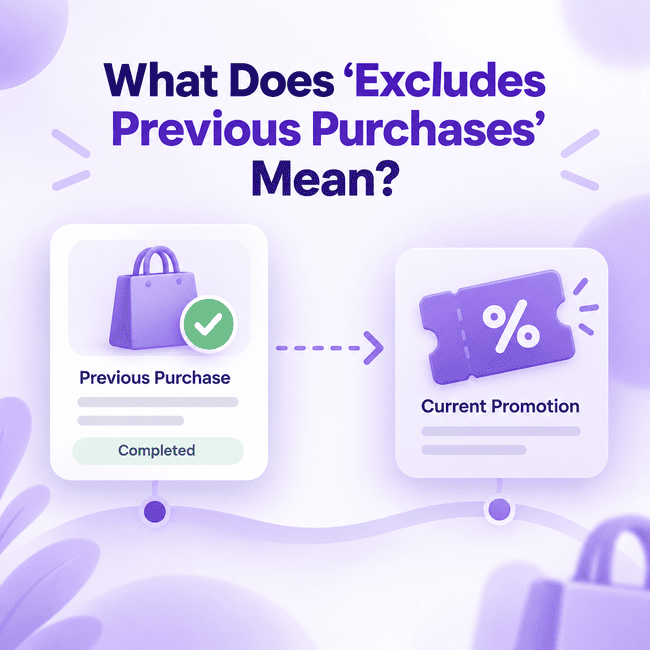
What Does “Excludes Previous Purchases” Mean?
When promotion terms say “excludes previous purchases,” it generally means the offer is not intended to apply automatically to orders that were already completed before the promotion was used.
The restriction focuses on purchase timing and order status.
It does not necessarily tell you what separate post-purchase policies a retailer may have.
For example, the phrase does not automatically answer whether the retailer offers:
- a post-purchase adjustment;
- another customer-service option;
- a separate pricing policy.
Those issues can be governed by different retailer rules.
For a broader explanation of similar conditions, see the guide to coupon restrictions.
Current vs Completed Orders
The difference between a current order and a completed order is central to this restriction.
Current Order
A current order is still within the active shopping or checkout process.
The shopper may still be able to review:
- eligible products;
- coupon requirements;
- purchase conditions;
- promotion timing;
- the final checkout result.
Completed Order
A completed order has already passed through the retailer’s purchase process.
Once that happens, a later promotion should not automatically be assumed to change the earlier transaction.
Retailers may define order statuses differently, so you should not rely on one universal technical definition of when an order becomes “completed.”
The practical distinction is:
Current order = promotion eligibility can still be evaluated during the purchase flow.
Completed order = post-purchase treatment may depend on separate retailer policies.
Coupon Timing
Timing can affect whether a coupon or promotion applies.
If an offer requires a coupon code, the retailer may require the code to be used during the qualifying purchase process.
Other promotions may use a different activation method.
The important point is that a promotion generally needs to meet its stated timing and redemption conditions.
If the order has already been completed before the offer is applied, the phrase “excludes previous purchases” usually indicates that the earlier purchase is outside the promotion’s intended scope.
This is different from coupon expiration.
An expiration condition asks whether the promotion is still valid.
A previous-purchase restriction asks whether an already completed order can fall within the promotion.
Can You Apply a Coupon After Purchase?
A coupon should not automatically be assumed to apply to an order after that order has already been completed.
If the promotion specifically says “excludes previous purchases,” the offer generally applies to qualifying purchases made under the promotion rather than retroactively changing earlier orders.
That does not mean every retailer has the same post-purchase policy.
A retailer may have separate rules for:
- price adjustments;
- customer-service requests;
- other post-purchase situations.
Whether any such option exists depends on the retailer’s own policy.
The promotion itself should not be treated as a guarantee that an earlier order can be changed.
If you are still in the active checkout process, the guide to where coupon codes are entered explains the pre-purchase side of coupon entry.
Post-Purchase Adjustments
A promotion and a post-purchase adjustment policy are two different things.
Promotion Eligibility
Promotion terms explain whether a purchase qualifies for the offer.
They may address:
- timing;
- eligible products;
- customer eligibility;
- minimum purchase requirements;
- previous purchases;
- other restrictions.
Post-Purchase Adjustment Policy
A retailer may separately have rules covering completed orders.
Those rules are not automatically part of the coupon or promotion itself.
If such a policy exists, it may have its own conditions.
You should not assume that a retailer will:
- refund the difference;
- apply a missed coupon;
- issue store credit;
- modify the completed order;
- cancel and recreate the purchase.
Those outcomes depend on the retailer’s separate policies.
The useful distinction is:
Promotion terms determine whether the offer applies.
Adjustment policies determine whether any separate post-purchase option exists.
What Do Promotion Terms Usually Control?
Promotion terms can define the boundaries of the offer.
They may explain:
- which purchases qualify;
- whether previous purchases are excluded;
- when the promotion is valid;
- whether a coupon code is required;
- which products are eligible;
- whether a minimum purchase applies;
- other restrictions.
For example, a promotion could require both:
- a qualifying current purchase;
- a minimum purchase requirement.
Meeting the threshold would not make an earlier completed order eligible if previous purchases are excluded.
Each condition should be checked separately.
“Excludes Previous Purchases” vs New-Customer Eligibility
These two restrictions can both involve purchase history, but they focus on different questions.
Excludes Previous Purchases
This restriction focuses on whether an already completed order can qualify for the current promotion.
The key issue is purchase timing or order status.
New Customers Only
This restriction focuses on who qualifies as a customer under the retailer’s terms.
The key issue is customer eligibility.
They should not be treated as the same condition.
A current purchase could be made by a returning customer.
A new customer could also have completed an earlier order before another promotion appeared.
For more detail on the customer-level distinction, see new-customer eligibility.
Previous Purchases vs Minimum Purchase
A previous-purchase restriction and a minimum-purchase restriction also address different parts of the promotion.
Previous Purchases Excluded
Focus:
when the order was made or whether it was already completed.
Minimum Purchase
Focus:
whether the qualifying purchase reaches the required threshold.
A promotion may include both restrictions.
For example, a current purchase may meet the minimum requirement and qualify under the timing rules.
A completed earlier purchase may meet the same threshold but still fall outside the offer because previous purchases are excluded.
This shows why promotion conditions should be evaluated together rather than one at a time.
What to Do After an Order Is Completed
If you notice a promotion after completing an order, use a policy-neutral approach.
1. Read the Promotion Terms
Check whether the offer says:
- excludes previous purchases;
- not valid on previous purchases;
- another similar restriction.
The exact wording matters.
2. Check Whether the Order Is Already Completed
Determine whether the purchase is still in an active checkout process or has already been completed under the retailer’s system.
Do not assume every retailer defines completion in exactly the same way.
3. Separate the Promotion From Other Policies
The coupon or promotion may exclude previous purchases while the retailer separately maintains another post-purchase policy.
These are different rules.
4. Do Not Assume Retroactive Application
A new coupon or promotion should not automatically be expected to change an earlier completed order.
If another option exists, it will depend on the retailer’s own policy.
5. Review Any Available Terms Before Acting
If the retailer provides information about completed orders or adjustments, review those terms separately.
Avoid assuming that canceling, reordering, requesting a refund, or another action will produce a particular result.
Common Misunderstandings
“I Found a Coupon After Buying, So the Retailer Must Apply It”
No.
If previous purchases are excluded, the promotion generally should not be assumed to apply retroactively.
Any separate post-purchase option depends on retailer policy.
“Excludes Previous Purchases Means Returning Customers Cannot Use the Offer”
Not necessarily.
Previous-purchase restrictions focus on completed orders, while returning-customer or new-customer rules focus on customer eligibility.
“A Completed Order Can Never Be Adjusted”
That is also too broad.
The promotion may exclude previous purchases, but a retailer could separately have another policy governing completed orders.
The two should not be confused.
“Reaching the Minimum Purchase Makes an Earlier Order Eligible”
Not necessarily.
A minimum-purchase condition and a previous-purchase restriction are separate requirements.
FAQ
Can I apply a coupon after purchase?
Do not assume that you can. If the promotion excludes previous purchases, it generally is not intended to apply automatically to an already completed order. Any separate post-purchase option depends on the retailer’s own policy.
What does previous purchase mean?
It broadly refers to an order that was already completed before the relevant promotion was applied. Retailers may define order status differently, so the exact interpretation should come from their terms.
Will a retailer adjust an order if I forgot a code?
There is no universal rule. A retailer may or may not have a separate post-purchase adjustment policy. The coupon itself should not be treated as a promise of a refund, price adjustment, or order change.
Is “excludes previous purchases” the same as “new customers only”?
No. “Excludes previous purchases” focuses on order timing or status, while “new customers only” focuses on customer eligibility.
Conclusion
“Excludes previous purchases” generally means a promotion is intended for qualifying purchases made under the offer rather than automatically changing orders that were already completed.
Keep promotion eligibility separate from any retailer-specific post-purchase adjustment policy.
Review the relevant offer terms and final cost before you buy.