
“Eligible purchase” means an order meets the promotion’s stated requirements. Product eligibility, thresholds, customer conditions, timing, and exclusions can all matter.
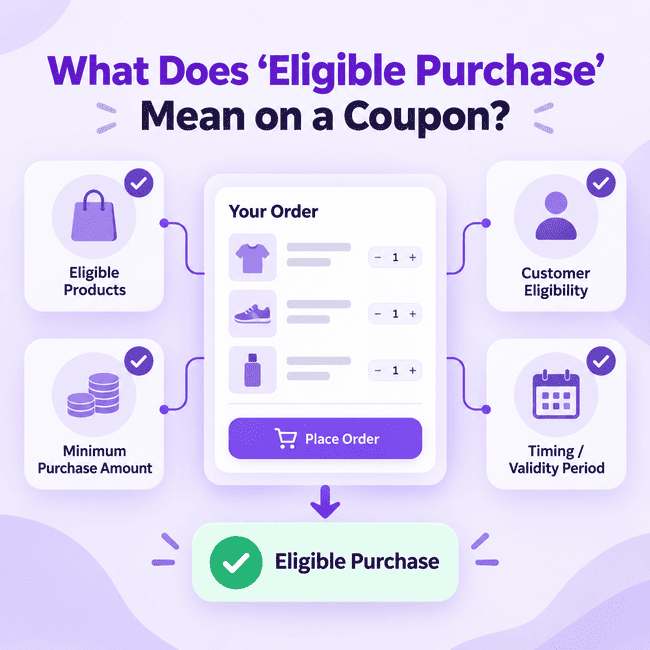
What Does “Eligible Purchase” Mean?
When a coupon or promotion refers to an “eligible purchase,” it generally means an order that meets the conditions required for the offer to apply.
This is a broad eligibility concept.
An eligible purchase may need to satisfy more than one requirement, such as:
- eligible products;
- a minimum purchase amount;
- customer eligibility;
- promotion timing;
- exclusions;
- other stated conditions.
Meeting only one condition does not necessarily make the entire order eligible.
For a broader overview of these types of conditions, see the guide to coupon restrictions.
Eligible Products
Product eligibility is one part of an eligible purchase.
A promotion may apply only to:
- selected products;
- specific categories;
- retailer-defined product groups;
- another stated set of qualifying items.
An order can include both eligible and ineligible products.
The presence of one qualifying item does not automatically mean the entire purchase qualifies for every part of the promotion.
Likewise, a product may appear suitable for the offer but still be affected by another restriction.
This is why product eligibility should be checked together with the other terms.
Minimum Purchase Requirements
A minimum purchase requirement is another possible condition.
This usually means the order must reach a stated qualifying threshold before the promotion can apply.
However, an eligible purchase and a minimum purchase are not the same thing.
A minimum purchase is one requirement.
An eligible purchase is the broader result of meeting all applicable requirements.
For example, an order could potentially meet the required purchase threshold but still fail another condition because:
- the products are not eligible;
- the customer does not qualify;
- an exclusion applies;
- the promotion period has ended;
- another requirement is not met.
The guide to a minimum purchase requirement explains that threshold condition separately.
The important distinction is:
Minimum purchase = one eligibility condition.
Eligible purchase = the order satisfies the applicable conditions as a whole.
Exclusions
Exclusions can also affect whether a purchase qualifies.
A coupon may exclude:
- certain products;
- particular categories;
- sale or clearance merchandise;
- another retailer-defined group.
An order may otherwise appear to qualify but still contain an excluded item or purchase type.
That does not automatically tell you how the retailer will handle the full cart.
The promotion may:
- apply only to eligible items;
- leave excluded items unchanged;
- fail if another condition is not met;
- produce another result under the retailer’s rules.
For more detail on this type of restriction, see coupon exclusions.
The key point is that exclusions are one part of the broader eligibility decision.
Customer Eligibility
Some promotions also include customer-level conditions.
For example, the offer may be restricted to a retailer-defined customer group.
That could involve:
- new-customer eligibility;
- another stated customer condition;
- a usage-related restriction.
You should not assume that every shopper qualifies simply because the product and order value meet the requirements.
A purchase can satisfy product and threshold conditions while still failing a separate customer condition.
The guide to new-customer eligibility explains one common example.
The exact customer definition should always come from the retailer’s terms.
Promotion Period
Timing can also determine whether a purchase is eligible.
A promotion may only apply during a stated period.
That means an otherwise qualifying order may not be eligible if the required purchase or redemption occurs outside the promotion window.
You should check:
- when the offer begins;
- when it ends;
- whether any timing conditions are stated;
- whether the promotion is still available at checkout.
Do not assume a universal cutoff or timezone rule unless the retailer provides that information.
Timing is simply another eligibility layer that can affect the final result.
How the Cart Is Evaluated
When you apply a coupon or reach checkout, the retailer may evaluate multiple promotion conditions.
These can include:
- product eligibility;
- minimum purchase requirements;
- exclusions;
- customer eligibility;
- promotion timing;
- other stated restrictions.
You should not assume that retailers check these conditions in a particular order.
The checkout may simply show the final result after the applicable rules have been evaluated.
Possible outcomes can include:
- the coupon applies;
- only some items receive the promotion;
- the offer is rejected;
- another condition prevents the expected result.
The useful question is not which rule was checked first.
The useful question is whether the order satisfies all relevant conditions.
Eligible Purchase vs Eligible Product
These two terms are related but different.
Eligible Product
An eligible product is an item that qualifies under the product rules of the promotion.
Eligible Purchase
An eligible purchase is the broader order that meets the applicable promotion requirements.
This distinction matters because an order can contain an eligible product but still fail another condition.
For example, the order might:
- fall below a minimum purchase requirement;
- contain an exclusion;
- fail customer eligibility;
- fall outside the promotion period.
That means:
Eligible product does not automatically equal eligible purchase.
Product eligibility is only one part of the overall order qualification.
How to Check Whether Your Order Qualifies
When a promotion refers to an eligible or qualifying purchase, review all of the stated conditions rather than focusing on only one.
1. Check Eligible Products
Confirm whether the products or categories in the cart are included in the promotion.
2. Check the Minimum Purchase Requirement
If a threshold applies, confirm whether the qualifying order value meets it.
Do not assume every item in the cart counts toward the requirement unless the terms say so.
3. Review Exclusions
Look for excluded products, categories, purchase types, or other restrictions.
4. Check Customer Eligibility
If the offer is restricted to a particular customer group, verify that condition separately.
5. Check the Promotion Period
Confirm that the offer is still available under the stated timing rules.
6. Review Other Conditions
Some promotions may include additional requirements beyond the main eligibility criteria.
Read the full terms rather than relying only on the headline offer.
7. Check the Final Checkout Result
Before completing the purchase, review:
- whether the coupon was accepted;
- which items received the promotion;
- whether another restriction affected the order;
- the final order total.
The checkout result helps confirm how the retailer applied the promotion rules to the specific purchase.
Common Misunderstandings
“Eligible Purchase Means I Only Need to Reach the Minimum Purchase”
Not necessarily.
A minimum purchase can be one condition, but product eligibility, customer rules, timing, and exclusions may also matter.
“If One Product Qualifies, the Whole Order Is Eligible”
Not necessarily.
An eligible product is only one part of the order.
Other requirements may still affect whether the full purchase qualifies.
“Eligible Purchase Only Refers to Products”
No.
The phrase can involve multiple types of conditions, including order value, customer eligibility, timing, and exclusions.
“If the Coupon Is Rejected, the Products Must Be Ineligible”
Not necessarily.
The order may fail another condition.
A rejection alone does not identify which eligibility rule caused the result.
FAQ
What makes a purchase eligible?
A purchase is generally eligible when it meets the promotion’s stated requirements. These can include eligible products, minimum purchase conditions, customer eligibility, timing, exclusions, and other terms.
Is an eligible purchase the same as a minimum purchase?
No. A minimum purchase is one possible threshold condition. An eligible purchase is the broader order that satisfies all applicable promotion requirements.
How do I know whether my order qualifies?
Review the offer terms for product eligibility, minimum purchase requirements, exclusions, customer conditions, timing, and other restrictions. Then check the final cart or checkout result.
Can an order contain an eligible product but still fail the coupon?
Yes. An eligible product can be part of an order that still fails another condition, such as a minimum purchase requirement, customer restriction, exclusion, or promotion timing rule.
Conclusion
“Eligible purchase” generally means an order that satisfies the applicable conditions of a coupon or promotion.
Those conditions can involve products, order value, exclusions, customer eligibility, timing, and other requirements.
Review the relevant offer terms and final cost before you buy.