
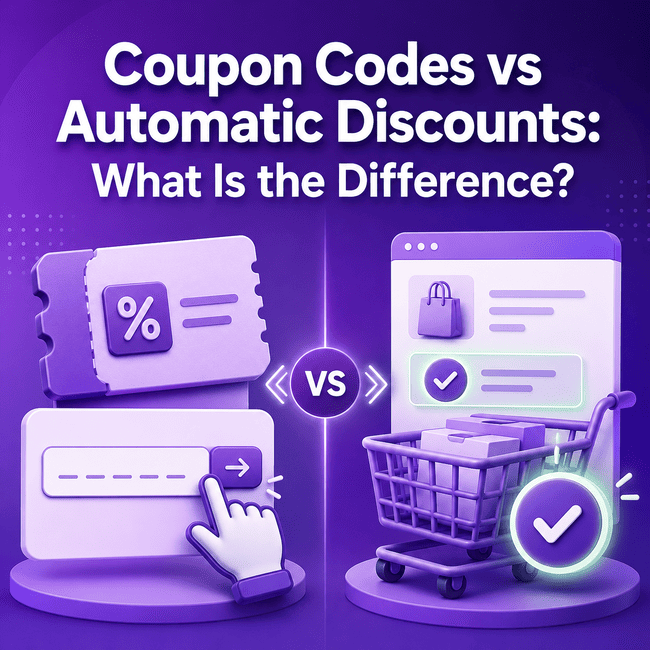
Coupon codes usually need to be entered manually, while automatic discounts are applied by the retailer when an order meets the promotion conditions.
What Is a Coupon Code?
A coupon code is a promotional code that a shopper enters during the cart or checkout process.
Depending on the retailer, similar offers may also be called:
- promo codes
- discount codes
- promotional codes
The terminology can vary, but the basic mechanism is similar: the shopper enters a code and the retailer checks whether the order meets the promotion conditions.
A coupon code may depend on factors such as:
- eligible products
- minimum purchase requirements
- exclusions
- promotion timing
- customer eligibility
- location
- whether other promotions are already applied
Entering a code does not guarantee that the discount will apply.
If you want more context on the terminology, see the guide to coupon, promo code, and discount code.
What Is an Automatic Discount?
An automatic discount is a promotion that the retailer’s system applies without requiring the shopper to enter a coupon code.
The promotion may appear when the order meets defined conditions.
Those conditions can relate to:
- qualifying products
- order value
- quantity
- promotion timing
- customer eligibility
- other retailer-defined requirements
For example, an automatic promotion may appear after qualifying products are added to the cart.
The important point is that there is no code-entry step.
However, automatic does not mean unconditional.
The retailer still determines whether the order qualifies.
How Coupon Codes Work
A code-based promotion generally follows this process.
1. Find or Receive the Code
The shopper obtains a coupon, promo, or discount code from a relevant source.
2. Add Products to the Cart
The products need to meet the promotion requirements.
3. Enter the Code
The shopper enters the code into the appropriate cart or checkout field.
4. Apply the Code
The retailer’s system checks the order against the promotion conditions.
5. Review the Result
The shopper checks whether the discount or offer appears in the order.
The key characteristic is that the shopper takes a manual action by entering the code.
A code can still fail if the products, order value, or other conditions are not eligible.
General coupon restrictions can help explain why a code does not apply to every order.
How Automatic Discounts Work
An automatic discount removes the code-entry step.
The process may look like this:
1. Add Qualifying Products
The shopper adds products to the cart.
2. Meet the Promotion Conditions
The order must satisfy any eligibility requirements defined by the retailer.
3. The Retailer Checks the Order
The store’s system evaluates the cart.
4. The Discount May Be Applied
If the conditions are met, the promotion can appear automatically.
5. Review the Cart or Checkout
The shopper confirms whether the expected promotion actually appears.
This makes the process different from a coupon code, but the underlying principle remains similar:
The promotion applies only when the order meets its conditions.
Coupon Code vs Automatic Discount: Key Differences
The main difference is how the promotion is applied.
| Feature | Coupon Code | Automatic Discount |
|---|---|---|
| Code required | Usually yes | No |
| Shopper action | Enter and apply the code | No code entry |
| Eligibility requirements | Can apply | Can apply |
| Product restrictions | May apply | May apply |
| Minimum purchase | May apply | May apply |
| Checkout review | Required | Required |
| Can fail to apply | Yes | Yes |
Neither mechanism guarantees that every shopper or product qualifies.
Both can include restrictions.
Both should be reviewed in the cart or checkout before the purchase is completed.
Examples of How Each Promotion May Appear
The following examples are hypothetical.
Example 1: Coupon Code
A shopper finds a promotion that includes a code.
They add the intended products to the cart, enter the code, and apply it.
If the order meets the promotion terms, the retailer may update the order total.
If the requirements are not met, the code may not apply.
Example 2: Automatic Discount
A shopper adds qualifying products to the cart.
The retailer’s system identifies that the order meets the promotion conditions and applies a discount automatically.
The shopper does not need to enter a code.
Example 3: The Promotion Does Not Apply
A shopper adds products that fall outside the eligible group.
In this situation:
- a coupon code may be rejected or have no effect
- an automatic discount may not appear
The difference is how the promotion is triggered, not whether eligibility rules exist.
Characteristics and Limitations of Coupon Codes
Coupon codes have several practical characteristics.
Manual Entry
The shopper needs to enter the code.
This means entry mistakes can affect the result.
Visible Promotion Identifier
A shopper can usually identify the specific code they are attempting to use.
That makes it easier to compare the code with its stated terms.
Eligibility Still Matters
A valid code may not apply to every product or order.
Entry Errors Can Occur
Problems can include:
- missing characters
- extra spaces
- entering the wrong code
- using the wrong checkout field
Restrictions May Apply
Coupon codes can include minimum purchase requirements, exclusions, timing rules, or other conditions.
If you are unsure whether a code applies, see how to check whether a coupon code applies.
Characteristics and Limitations of Automatic Discounts
Automatic discounts remove the manual code-entry step, but they can still have conditions.
No Code Entry
The shopper does not need to type or paste a code.
System-Based Application
The retailer’s system determines whether the order meets the offer conditions.
Restrictions Can Still Apply
Automatic promotions may be limited by:
- products
- order value
- quantity
- timing
- customer eligibility
- other retailer-defined terms
The Discount May Not Appear
If the conditions are not met, the promotion may not be applied.
Checkout Still Needs to Be Reviewed
Even when a promotion is automatic, shoppers should confirm what appears in the order summary.
Automatic does not mean the result should be assumed.
Sale Price vs Coupon Code vs Automatic Discount
A sale price, coupon code, and automatic discount can all reduce the cost of a purchase, but they work differently.
Sale Price
A sale price is typically reflected directly in the displayed product price.
The shopper may not need to take any additional action.
Coupon Code
A coupon code normally requires the shopper to enter a code and apply it.
Automatic Discount
An automatic discount is applied by the retailer’s system when the order meets the promotion conditions.
The distinction can be summarized as:
- Sale price: reflected directly in product pricing.
- Coupon code: manually entered.
- Automatic discount: applied by the system when eligible.
These mechanisms can also exist at the same time.
That does not mean they can always be combined.
Can Coupon Codes and Automatic Discounts Be Combined?
Sometimes, but not always.
Whether a coupon code and an automatic discount can be used on the same order depends on:
- the retailer’s rules
- the terms of each promotion
- product eligibility
- minimum purchase requirements
- combination or stacking restrictions
Possible outcomes include:
- both promotions apply
- the coupon replaces the automatic discount
- the automatic discount remains and the coupon is rejected
- only one promotion is permitted
There is no universal stacking rule.
If you are trying to use several promotions together, see the guide to combining coupons and discounts.
How to Check Which Discount Applied
When several types of promotions appear around the same purchase, review the cart carefully.
1. Check the Product Price
Start with the displayed product price.
This helps identify whether the item already has a sale price.
2. Look for an Automatic Promotion
Add the intended products to the cart and see whether a discount appears before entering a code.
3. Enter the Coupon If Applicable
If you have a code, apply it according to the retailer’s checkout process.
4. Review What Changes
Check whether:
- the automatic promotion remains
- the coupon appears
- one promotion replaces another
- the order total changes
5. Read the Promotion Terms
If the result is different from what you expected, review the combination rules and eligibility requirements.
6. Check the Final Checkout Total
The final order summary is the most useful place to see which promotions are actually affecting the purchase.
When comparing different offer structures, compare the final cost rather than focusing only on how many discounts appear.
Which Type of Discount Is Better?
There is no universal answer.
A coupon code is not automatically better than an automatic discount, and an automatic discount is not automatically better than a sale price.
The result depends on:
- the products
- the starting price
- eligibility
- restrictions
- other promotions
- shipping
- the final order total
The useful comparison is the actual effect on the purchase.
Two promotions with different mechanisms may produce similar results, or one may apply while the other does not.
Frequently Asked Questions
Do automatic discounts require a code?
Usually no. An automatic discount is applied by the retailer’s system when the order meets the promotion conditions, so the shopper does not normally enter a coupon code. However, eligibility requirements, product restrictions, minimum purchases, or other terms may still apply.
Can automatic discounts and coupons be combined?
Sometimes. Whether an automatic discount and coupon code can be used together depends on the retailer and the terms of both promotions. One offer may remain, both may apply, or one may replace the other. Check the promotion rules and cart result.
Is an automatic discount the same as a sale price?
Not necessarily. A sale price is generally reflected directly in the product price, while an automatic discount may be applied after the order meets certain conditions. Both can reduce the purchase cost, but they use different promotion mechanisms.
Conclusion
Coupon codes and automatic discounts differ mainly in how they are applied.
A coupon code normally requires manual entry, while an automatic discount is applied by the retailer’s system when qualifying conditions are met.
Both can include restrictions, and neither should be assumed to apply until the cart or checkout confirms the result.